
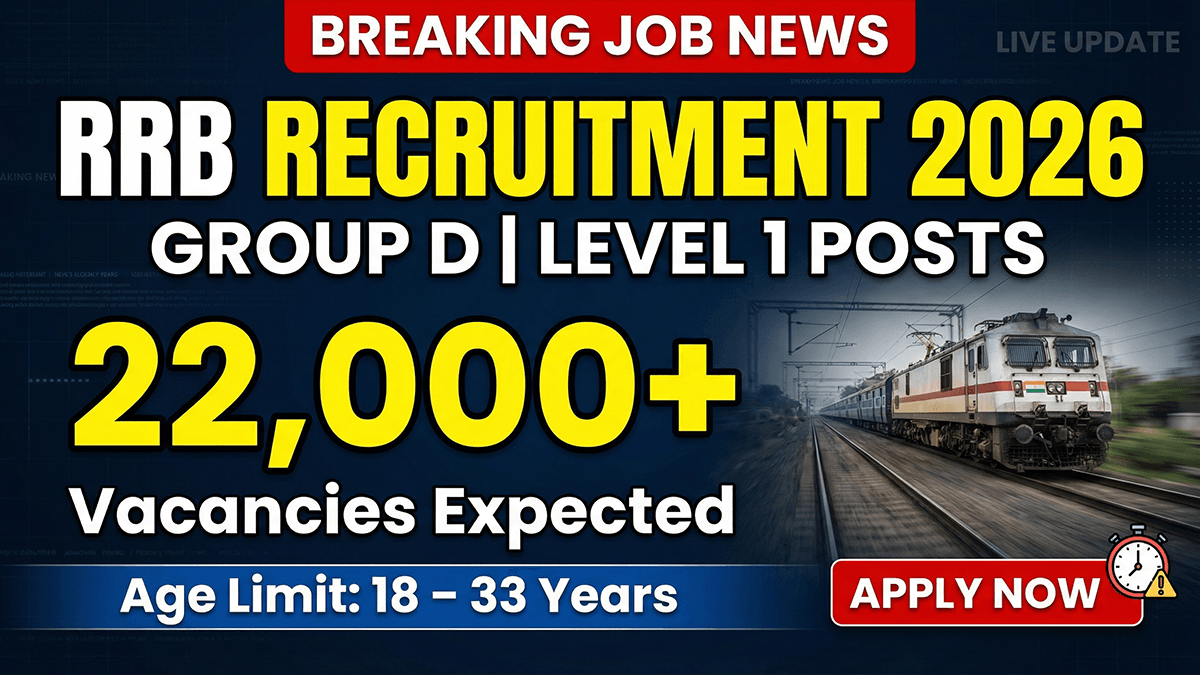
You’ve probably scrolled through hundreds of job portals, watched countless “success stories,” and thought: Is RRB Group D recruitment 2026 worth the hype?
Let me be brutally honest with you. The Railway Recruitment Board has announced 22,000 Level-1 vacancies for 2026, which sounds enormous until you realize that crores of candidates apply simultaneously. That’s an average competition ratio of roughly 1 in 1,500 candidates. But before you dismiss this as “impossible,” here’s the truth: with proper strategy, the right preparation approach, and a realistic understanding of what the job entails, RRB Group D Recruitment 2026 remains one of the most achievable government jobs for 10th pass and ITI holders in India.
This comprehensive guide will walk you through everything you need to know—from the raw reality of the vacancies and salaries to the harsh truths about the work environment and competition levels. By the end, you’ll have a clear answer: Should you apply?
Vacancy Analysis: Understanding What Jobs Are Actually Available

The 22,000 vacancies for RRB Group D Recruitment 2026 aren’t evenly distributed across all posts. This matters because different roles have drastically different competition levels, work profiles, and long-term career prospects.
Post-Wise Vacancy Breakdown
| Post Name | Vacancies | Department | Work Profile Intensity |
| Track Maintainer Grade IV | 11,000 | Engineering | 🔴 High Demand |
| Pointsman-B | 5,000 | Traffic | 🟡 Moderate Demand |
| Assistant (S&T) | 1,500 | Signal & Telecom | 🟢 Low-Moderate Demand |
| Assistant (C&W) | 1,000 | Mechanical (Coaches) | 🟡 Moderate Demand |
| Assistant (TRD) | 800 | Electrical Distribution | 🟡 Moderate Demand |
| Assistant (Bridge) | 600 | Engineering | 🔴 High Demand |
| Assistant (Track Machine) | 600 | Engineering | 🟡 Moderate Demand |
| Other Posts | 1,500 | Various | Varies |
| Total | 22,000 | — | — |
What Each Post Actually Demands from You
Track Maintainer Grade IV (50% of all posts) – 🔴 Hard Work Level: 9/10 – This is the backbone of RRB recruitment. Your job? Inspect railway tracks daily, identify cracks or defects, replace sleepers and rails, and ensure trains run safely. You’ll work outdoors in extreme weather—scorching summers, freezing winters, monsoon rains. Work starts at 5 AM, involves heavy lifting (30+ kg regularly), and includes weekend shifts. Physical Demand: 9/10.
Pointsman-B (23% of posts) – 🟡 Hard Work Level: 7/10 – Operating railway switches to direct train movements. You’ll stand for 8+ hours in a cabin, manage track switching levers, coordinate with station masters, and ensure safe train routing. Mental alertness is critical; one mistake can cause accidents. Physical Demand: 4/10.
Assistant in S&T (Signal & Telecommunication) – 🟢 Hard Work Level: 5/10 – Maintaining signalling and communication systems. Lower physical demand compared to track roles, but requires technical troubleshooting skills. Growing in demand as railways digitalize. Physical Demand: 5/10.
Assistant (C&W) – Carriage & Wagon – 🟡 Hard Work Level: 6/10 – Maintaining passenger and freight coaches. Involves working inside workshops, fixing electrical and mechanical issues. Relatively stable work environment, less outdoor exposure. Physical Demand: 6/10.
The brutal truth: 50% of all vacancies are for Track Maintainer—the physically most demanding role with the worst working conditions. If you’re aiming for a “cushy” government job without fieldwork, RRB Group D is NOT for you.
Eligibility Criteria: Clearing Up the Confusion
Basic Requirements
| Criteria | Requirement |
| Minimum Age | 18 years (as on 01/01/2026) |
| Maximum Age | 33 years (General) |
| Nationality | Indian |
| Education | 10th Pass OR ITI Certificate from NCVT/SCVT |
| Experience | Not mandatory |
Age Relaxation: Who Gets Extra Years?
| Category | Age Relaxation | Maximum Age |
| Unreserved (UR) | No relaxation | 33 years |
| OBC (Non-Creamy) | +3 years | 36 years |
| SC/ST | +5 years | 38 years |
| EWS | No relaxation (unless ex-servicemen) | 33 years |
| PwBD (General) | +10 years | 43 years |
| PwBD (OBC) | +13 years | 46 years |
| PwBD (SC/ST) | +15 years | 48-53 years |
| Ex-Servicemen | Variable (+3-8 years depending on category & service) | Up to 40-45 years |
The Confusion Resolved: ITI vs. 10th Pass – Both are equally eligible. You don’t need both. If you’re a 10th pass with an ITI diploma, great. If you’re only 10th pass, still eligible. If you’re ITI graduate without 10th, still eligible for most posts (verify in detailed notification).
Age Calculation: Your age on 1st January 2026 is what matters—not today, not the application date.
Salary Breakdown: What You’ll Actually Earn In-Hand
This is where many candidates get disappointed. The RRB Group D salary looks attractive on paper—but only if you understand how it’s calculated and what gets deducted.
Salary Structure (7th Pay Commission)
| Component | Amount | Notes |
| Basic Pay | ₹18,000 | Fixed |
| Grade Pay | Included in Basic | (7th CPC format) |
| Dearness Allowance (DA) | ₹3,060 | Approximate; increases annually |
| HRA (House Rent Allowance) | 8%-24% of Basic | Depends on city category |
| Transport Allowance (TA) | ₹1,800 (variable) | Depends on posting location |
| Night Duty Allowance | Extra | If assigned night shifts |
| Gross Salary | ₹25,560–₹27,920 | Varies by city |
Calculating Your Actual In-Hand Salary
Let’s break down what you’ll ACTUALLY receive each month. Here’s a realistic example for a Track Maintainer posted in a Y-category city (most common postings):
Gross Salary Calculation: – Basic Pay: ₹18,000 – DA: ₹3,060 – HRA (16% of Basic): ₹2,880 – TA: ₹1,800 – Gross = ₹25,740
Mandatory Deductions: – National Pension Scheme (NPS, 10% of Basic): ₹1,800 – Professional Tax (PT): ₹200–₹250 – Group Insurance Scheme (GIS): ₹500–₹600 – Total Deductions ≈ ₹2,500–₹2,650
Your Actual In-Hand Salary: ₹23,090–₹23,240[26]
The Real Situation: Your in-hand salary is roughly ₹23,000–₹24,500, not the advertised ₹25,000+. After 5 years of service, with DA increases and potential allowances, it may reach ₹28,000–₹32,000. But at entry level? Budget for ₹23,500 as your monthly take-home.
Selection Strategy: How to Pass This Exam (Safe Zones & Preparation)
The RRB Group D Recruitment 2026 selection process has 4 stages. Failing even one stage means rejection—no second chances.
Selection Process Overview
Stage 1: Computer-Based Test (CBT-1) – 100 MCQs, 90 minutes – Mathematics (25 questions) – General Intelligence & Reasoning (25 questions) – General Science (25 questions) – General Awareness & Current Affairs (25 questions) – Negative marking: 1/3 mark per wrong answer – Qualifying marks: 40% (UR/EWS), 30% (OBC/SC), 25% (ST)
Stage 2: Physical Efficiency Test (PET) – Qualifying nature (no marks) – Male candidates: – Lift & carry 35 kg for 100 meters in 2 minutes (one attempt only) – Run 1000 meters in 4 minutes 15 seconds (one attempt only) – Female candidates: – Lift & carry 20 kg for 100 meters in 2 minutes – Run 1000 meters in 5 minutes 40 seconds
Stage 3: Document Verification (DV) – Candidates called in a 1:1 Ratio (Equal to vacancies) based on CBT merit
Stage 4: Medical Examination – Fitness assessment
Your Safe Zone Strategy for CBT
Mathematics (The Scoring Section) – Focus on: Time & Work, Profit & Loss, Ratio & Proportion, HCF/LCM, Basic Geometry – Target: 15+ correct (out of 25) = Safe zone – Best Books: Fast Track Objective Arithmetic (Rajesh Verma), Practice Book on Quicker Maths (M. Tyra)
General Intelligence & Reasoning – Focus on: Analogy, Series, Classification, Coding-Decoding (Logic-based, not data interpretation) – Target: 12+ correct = Safe zone – Best Books: A Modern Approach to Reasoning (RS Aggarwal), Test of Reasoning (Edgar Thorpe)
General Science (Easy but often ignored) – Focus on: Basic Physics (Motion, Force), Chemistry (Acids, Bases), Biology (Digestion, Respiration) – Target: 18+ correct = Achievable (this section has easiest questions) – Best Books: Lucent’s General Science, General Knowledge by Disha
General Awareness (Current Events + Static) – Focus on: National/International news from last 6 months, Sports, Awards, Government schemes – Target: 10+ correct = Safe zone – Source: Pratiyogita Darpan, Manorama Year Book, Daily news reading
The Safe Zone Total: 15 + 12 + 18 + 10 = 55 marks out of 100 = Well above 40% qualifying marks and enough to clear most zones (pending PET).
Physical Efficiency Test Preparation
This stage eliminates 20-30% of candidates. It’s not optional; it’s mandatory.
- Training Duration: Start 2-3 months before exam
- Weight Lifting: Practice with sandbags, kettlebells. Focus on maintaining perfect form
- Running: Include 1000m sprints, interval training, long-distance running (5-8 km)
- Pro Tip: PET is typically easier than CBT competition-wise. If you cleared CBT, PET is often just a formality if you’re reasonably fit
Why This Job is RISKY: The Harsh Truths No One Tells You
Before you decide to apply, here’s what you need to know about the downsides.
1. Extreme Working Conditions
Track Maintainer (the majority of posts): You’ll be working outdoors, on active railway lines, with trains passing by. Heat stress in summer, hypothermia in winter. You’ll get drenched in monsoons, covered in dust/grime, and exposed to industrial pollution. Protective gear? Basic. Workplace accidents? Not uncommon.
Pointsman & Signal Roles: Standing in confined spaces for 8+ hours, mental fatigue from constant vigilance, shift work disrupting sleep patterns.
2. 24×7 Shift Work and Work-Life Balance
Most RRB Group D employees work rotational shifts—morning, evening, and night shifts, sometimes on a 7-day cycle. This means: – Your weekends are irregular – Your sleep pattern is constantly disrupted – Family time is limited – Attending weddings, festivals, or important events becomes logistically difficult
3. High Competition Ratio
For 22,000 posts, if we conservatively estimate 3.3 crore applications (330 million), that’s a 1 in 1,500 success rate. Even after clearing CBT, you’re competing for limited DV slots called in a 1:1 ratio (equal to vacancies). One small mistake or bad luck in merit positioning = rejection.
4. Limited Career Ceiling Without Further Qualifications
- Promotion to Group C requires passing a departmental exam AND having 3 years service + a typing speed of 30 wpm (English)
- Not everyone can clear departmental exams; competition here is also high
- Without promotion, you’ll retire as a Track Maintainer or Pointsman—no dramatic salary jumps
- Max salary in Group D is ₹25,000-₹26,000. After promotion to Group C, it jumps to ₹25,500-₹35,400—but you need to clear the exam first
5. Mandatory Medical and Physical Standards
Vision requirements (distant and near vision), hearing standards, blood pressure norms. If you have any medical condition, you might be rejected at the final stage after clearing everything else.
Why This Job is GOOD: The Benefits That Make It Worth It
Now, the other side of the coin.
1. Job Security in an Uncertain World
Once you’re appointed, you have a permanent government job. Recession? Doesn’t matter. Economic slowdown? You’re protected. This is the single biggest advantage. In today’s economy, where startups shut down and companies downsize, a railway job is a fortress.
2. Structured Career Progression
- Automatic salary increments every year (within pay scale)
- After 3 years, eligible for Group C promotion (higher pay scale: ₹25,500–₹35,400)
- Further advancement to Junior Engineer (JE), Senior Section Engineer (SSE)—if you pursue additional qualifications or excel in departmental exams
- Clear hierarchy and transparent promotion policy
3. Comprehensive Benefits Package
Beyond the salary, you get: – Medical Coverage: Free treatment at railway hospitals for you + dependents – Pension: National Pension Scheme (NPS) contributions, ensuring post-retirement income – Travel Benefits: Complimentary railway passes for you and family (up to 8 passes/year after retirement) – Leave Benefits: Casual leave, earned leave, sick leave (typical government employee benefits) – Holiday Compensation: Extra pay if you work on national holidays – Gratuity & Provident Fund: Lump-sum payment + PF balance after retirement
4. Retirement Security
Your NPS contributions + government top-up = secure pension for life. Additionally, you’re eligible for a post-retirement complimentary pass and widow pass (for your spouse), meaning travel perks extend beyond your service.
5. Suitable for Candidates Without a Graduation Degree
If you’re from a rural background, couldn’t pursue college due to financial constraints, or just completed 10th + ITI—this is YOUR opportunity. Unlike UPSC or banking exams that demand graduates, RRB Group D opens doors for everyone with 10th pass credentials.
Final Verdict: Should YOU Apply for RRB Group D Recruitment 2026?
Apply if you: –
✅ Are physically fit and don’t mind strenuous outdoor work –
✅ Want absolute job security over high salary
✅ Can handle shift work and irregular schedules
✅ Are willing to spend 4-6 months in serious preparation
✅ Have cleared 10th or have an ITI certificate
✅ Value pension and long-term stability over short-term gains
✅ Are aged 18-33 (or within age relaxation for your category)
Don’t apply if you: –
❌ Have a health condition that might not pass the medical exam
❌ Are looking for high salary (start with ₹23,500 in-hand)
❌ Cannot handle physical labor or harsh weather
❌ Expect regular weekends and fixed work hours
❌ Have already secured a private sector job with better salary
❌ Cannot clear the Physical Efficiency Test (fitness requirement is non-negotiable)
The Realistic Outcome
Out of 3.3 crore applicants: – 50 lakh will clear CBT (15% of applicants) – 15-20 lakh will clear PET (70% of CBT qualifiers) – 22,000 will be selected
Your odds of selection: ~0.067% if you’re in the general category competing against all zones. But if you prepare properly and get lucky with merit positioning, you could be in that 22,000.
Application Timeline for RRB Group D Recruitment 2026
| Event | Date |
| Short Notification Released | 19 January 2026 |
| Detailed Notification Release | 30 January 2026 |
| Application Start | 31 January 2026 |
| Application End | 02 March 2026 |
| Application Status Check | April 2026 |
| Admit Card (Tentative) | June 2026 |
| CBT Exam Date (Tentative) | June-July 2026 |
Application Fee: ₹500 (General/OBC), ₹250 (SC/ST/PwBD)
Conclusion: Your Decision, Your Future
Ab Faisla Aapka Hai! Kya aap Track Maintainer ki kadi mehnat ke liye taiyar hain ya aap Smart Study karke S&T department ki job chahte hain?
RRB Group D Recruitment 2026 isn’t the “best opportunity” for everyone—but it might be for YOU. If you’re someone who values certainty over ambition, stability over risk, and long-term security over immediate high income, this is a calculated bet worth taking. The competition is fierce, yes. But with focused preparation, proper strategy, and realistic expectations about what the job entails, you have a fighting chance.
The 22,000 vacancies represent hope for millions of Indian youth seeking government employment. The question isn’t whether it’s possible—it’s whether you’re willing to put in the effort.
Sahi Zone chunne aur ‘Safe Score’ janne ke liye hamare Telegram Channel ko abhi join karein. Wahan hum ‘Zone-Wise Risk List’ aur ‘Subject-Wise Mock Tests’ share karenge.
[Join Telegram Channel – [Insert Channel Link Here]]
The detailed notification drops on 30 January 2026. Applications open on 31 January. You have roughly 30 days to register.
What will you do?
Frequently Asked Questions
Q: Is 10th pass enough, or do I need an ITI?
A: 10th pass alone is sufficient. ITI is an alternative, not a requirement. However, some posts may prefer ITI; check the detailed notification.
Q: What if I’m 35 years old? Can I apply?
A: Only if you fall under SC/ST category (they get +5 years relaxation). General category has a strict 33-year limit.
Q: Can I apply for multiple RRB zones simultaneously?
A: NO. This is a critical point. You can apply to ONLY ONE Railway Recruitment Cell (RRC). If you submit applications for multiple zones (e.g., Mumbai and Chennai both), ALL your applications will be rejected by the software. Choose your zone wisely before applying. Consider factors like: proximity to your home, ease of commute post-selection, local cost of living, and zone-specific competition levels.
Q: What is the in-hand salary for an RRB Group D employee?
A: While the basic pay is ₹18,000, including allowances like DA and HRA, the starting in-hand salary ranges from ₹23,000 to ₹24,500 per month. After 5 years of service, this can increase to approximately ₹32,000.
Q: When is the RRB Group D 2026 Exam Date?
A: According to the tentative schedule, the Computer-Based Test (CBT) is expected to be conducted in June-July 2026. Admit cards are typically released 10 days before the exam date.
Q: What’s the Document Verification ratio?
A: Based on recent trends (2019-24), Railways now calls candidates in a 1:1 Ratio (Equal to vacancies) for Document Verification to reduce waiting time. This means if there are 22,000 vacancies, approximately 22,000 candidates will be called for DV (2x ratio was used earlier, but this has been optimized).
Q: What are the Physical Test (PET) requirements for males and females?
Male Candidates: Lift 35kg for 100m (in 2 mins) and run 1000m in 4 mins 15 secs.
Female Candidates: Lift 20kg for 100m (in 2 mins) and run 1000m in 5 mins 40 secs.
Q: Is ITI mandatory for RRB Group D 2026, or can 10th pass candidates apply?
No, ITI is not mandatory for all posts. 10th Pass candidates are eligible to apply. While some technical posts may prefer ITI certification, non-technical roles remain open for candidates with just a 10th-grade qualification.
Q: When will the RRB Group D 2026 online application start?
The detailed notification is expected to be released on January 30, 2026, with online applications starting from January 31, 2026. The last date to submit the application is March 02, 2026.
